Ebola in Kenya: Is it under control as nine cases confirmed?
Kenya is hoping to bring its Ebola outbreak to an end as health officials work to stop the virus from spreading. So far, nine cases have been confirmed and two people have died.
The country announced its first case about three weeks ago. Now, the first 20 people who had contact with the first patient have completed quarantine and been released. The government called this an important step in controlling the outbreak.
Another 98 people remain in quarantine and are expected to be released next week if they stay healthy.
Kenya’s health officials hope the outbreak could be declared over in less than two months. However, this will only happen if no new cases appear.
Patrick Amoth, Kenya’s Director-General of Health, said people must remain careful until the outbreak is officially over. The World Health Organization’s rules require 42 days to pass after the last confirmed patient tests negative twice before an outbreak can be declared over.
Concerns about the virus spreading
Fear of further infections has grown across East and Central Africa. The outbreak in the Democratic Republic of Congo (DR Congo) has caused thousands of deaths, making it one of the deadliest Ebola outbreaks on record.
The International Rescue Committee says Kenya remains at risk because people travel across its borders from countries affected by the outbreak. Kenya is also an important transport centre for the region.
The current outbreak is caused by the Bundibugyo type of Ebola. There is no approved vaccine or treatment for this type, although researchers are testing possible options.
Kenya’s doctors’ union has raised concerns about a lack of staff and possible weaknesses in health checks at border crossings and the country’s main airport. The union says more workers are needed to help identify possible infections.
Kenya has introduced extra health checks for travellers arriving from 10 countries considered at high risk. These include DR Congo, Uganda, Tanzania, Rwanda, Burundi, Angola, Zambia, Ethiopia, South Sudan and the Central African Republic.
Travellers from these countries must complete an online health form before boarding their flights. They must also show a QR code to health officials when they arrive. Aircraft arriving from these countries are also subject to extra health checks.
Inside Kenya, officials are asking people to report possible Ebola symptoms quickly and seek medical help. The government has also set up treatment and isolation centres and trained health workers to handle possible cases.
A special laboratory has been established at Kenyatta National Hospital to test for Ebola while helping protect other laboratory facilities.
The government says all confirmed cases so far are linked to the first patient. Officials have found no evidence that the virus is spreading more widely through the community.
After the first case was confirmed on 6 October, health teams traced people who might have been exposed to the virus. The World Health Organization said that by 22 October, all known contacts in Kenya and other countries had been traced and placed in quarantine.
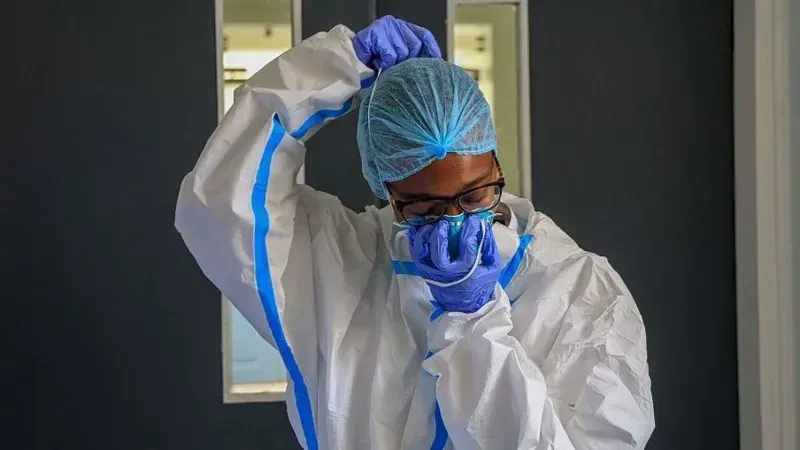
Nearly 5,000 healthcare workers have received training to help respond to Ebola. The government has also obtained protective equipment for medical staff.
However, three healthcare workers and a hospital cleaner have been among those infected. This has raised questions about whether medical staff are receiving enough protection.
Dennis Miskellah, a leader in Kenya’s medical practitioners’ union, said hospitals need enough protective equipment, especially when patients do not tell staff that they may have been in an area affected by Ebola.
He also called for better public education so that people feel safe reporting symptoms instead of hiding them because they fear being blamed or treated differently.
Ebola spreads through direct contact with infected bodily fluids, such as blood or vomit. Symptoms may take between two and 21 days to appear after exposure.
Kenya’s health ministry has urged people to wash their hands, avoid close contact with sick people and follow health advice. It has also warned against treating people unfairly because they have been identified as contacts of an infected person.
The government and the World Health Organization have shared public information encouraging people to support those affected and avoid spreading fear or stigma. A free emergency hotline, 719, is available for reporting suspected symptoms.
Neighbouring countries increase checks
Countries across the region are watching the situation closely and have strengthened their health checks.
Somalia is monitoring a person who came into contact with the man who died in Kenya. The person is in quarantine, and samples have been sent to Kenya for testing. The individual had travelled through Ethiopia, which has also increased surveillance.
Tanzania is monitoring visitors daily for 21 days. Uganda has maintained stronger health checks, and it has said that 60 people monitored after contact with the Kenyan patient have been released. The World Health Organization has also declared Uganda free of its earlier outbreak.
Nigeria confirmed an Ebola case on 20 October involving a 42-year-old Ugandan-born woman who travelled from Uganda to Abuja. Officials said she did not have symptoms while travelling through Uganda and became ill after reaching Nigeria. She was later taken to Switzerland for care.
The United States has advised its citizens to reconsider travel to Kenya because of the outbreak. The United Kingdom has warned travellers they may face extra health checks, while Canada has advised people to monitor their health for 21 days.
However, no country has banned all travel to Kenya, and Kenya has not introduced a national lockdown or general travel ban. Trade, travel and public gatherings are continuing.
There are concerns that the outbreak could affect tourism and international travel if it spreads further, but there is no evidence of such an impact so far.
For now, Kenya is relying on contact tracing, border checks, public education and hospital preparations to contain the virus. Health officials say the release of the first group from quarantine is encouraging, but they warn that the response must continue until the outbreak is officially over.